How to read your pay stub
Your pay stub explains where the gap between your salary and your deposit goes. Here is what each line means and what to check every payday.
Your offer letter says one number, and your bank deposit says a smaller one. The pay stub (also called an earnings statement) is the receipt that connects the two. Most stubs have the same five parts, even when the layout looks different. Once you know them, it takes about two minutes to check each paycheck.
Part 1: The header
The top of the stub shows your name, your employer, the pay period (the dates you worked) and the pay date. Check that the pay period lines up with your timesheet, especially after a schedule change or time off.
Part 2: Earnings (gross pay)
Gross pay is what you earned before anything comes out. Hourly workers will see hours multiplied by the rate, with overtime, holiday or shift pay on separate lines. Salaried workers usually see their yearly salary divided by the number of paychecks: 26 if you are paid every two weeks, 24 if twice a month.
You may also see YTD (year to date) next to each line. That is the running total since January 1.
Part 3: Pre-tax deductions
These come out of your pay before income tax is figured, which lowers your tax bill. Common ones:
- Health, dental and vision premiums paid through your employer's plan
- Traditional 401(k) or 403(b) contributions
- HSA or FSA contributions
One detail that surprises people: a traditional 401(k) contribution lowers the pay used for federal income tax, but not the pay used for Social Security and Medicare. Health premiums paid through a cafeteria plan usually lower both. That is why your stub may show two or three different "taxable wages" numbers.
Part 4: Taxes
- Federal income tax. The amount depends on your pay and on the Form W-4 you gave your employer.
- Social Security (often labeled OASDI or FICA-SS): 6.2% of your wages, up to a yearly cap. For 2026 the cap is $184,500; it changes each year. Your employer pays another 6.2% on top.
- Medicare (FICA-Med): 1.45% of all wages, with no cap. Once your wages pass $200,000 in a year, your employer also withholds an extra 0.9%.
- State and local income tax, if your state or city has one. Some states also take small amounts for disability or family leave programs.
Part 5: After-tax deductions and net pay
After taxes come any after-tax deductions, such as Roth 401(k) contributions, union dues or wage garnishments. What is left is net pay: the amount deposited to your account. Net pay is the number your budget should be built on.
A sample pay stub, line by line
Sam earns $52,000 a year, paid every two weeks, so each check starts at $2,000 gross. Sam puts 5% into a traditional 401(k) and pays $80 per check for health insurance.
| Line | This check | How it's figured |
|---|---|---|
| Gross pay | $2,000.00 | $52,000 ÷ 26 |
| Health insurance (pre-tax) | −$80.00 | Plan premium |
| 401(k), traditional | −$100.00 | 5% of $2,000 |
| Social Security | −$119.04 | 6.2% of $1,920 (gross minus health premium) |
| Medicare | −$27.84 | 1.45% of $1,920 |
| Federal income tax | −$150.00 | Example only; depends on your W-4 |
| State income tax | −$60.00 | Example only; varies by state |
| Net pay | $1,463.12 | What lands in the bank |
So a "$52,000 job" puts about $1,463 every two weeks into Sam's account in this example. If Sam budgeted from the salary instead, the plan would be off by more than $500 a check.
What to check every payday
- Hours and rate. Do they match what you worked and what you were promised?
- New or changed deductions. Open enrollment, a raise or a new benefit can quietly change your take-home pay. January paychecks often look different for this reason.
- Withholding that looks off. If federal tax suddenly jumps or drops, look at your W-4. The IRS has a free Tax Withholding Estimator that helps you adjust it so you don't owe a big bill or give the government an oversized refund.
- Net pay vs. your budget. If take-home pay changed, update your budget the same week.
Keep your stubs (paper or PDF) at least until you have checked them against your Form W-2 in January.
Turn your net pay into a plan
Once you know your real take-home number, give every check a job. Our free paycheck budget calculator splits it into bills, spending and savings in a few seconds. If you are paid every two weeks, the guide to budgeting biweekly pay shows how to match bills to paychecks and plan for the two 3-paycheck months each year.
What's your money style?
8 everyday money moments reveal your style, your blind spot and a 3-step plan. Compare with a partner.
Take the quiz →Budget your take-home pay
Enter the net pay from your stub and see how much goes to bills, spending and savings each check. No sign-up.
Open the paycheck calculator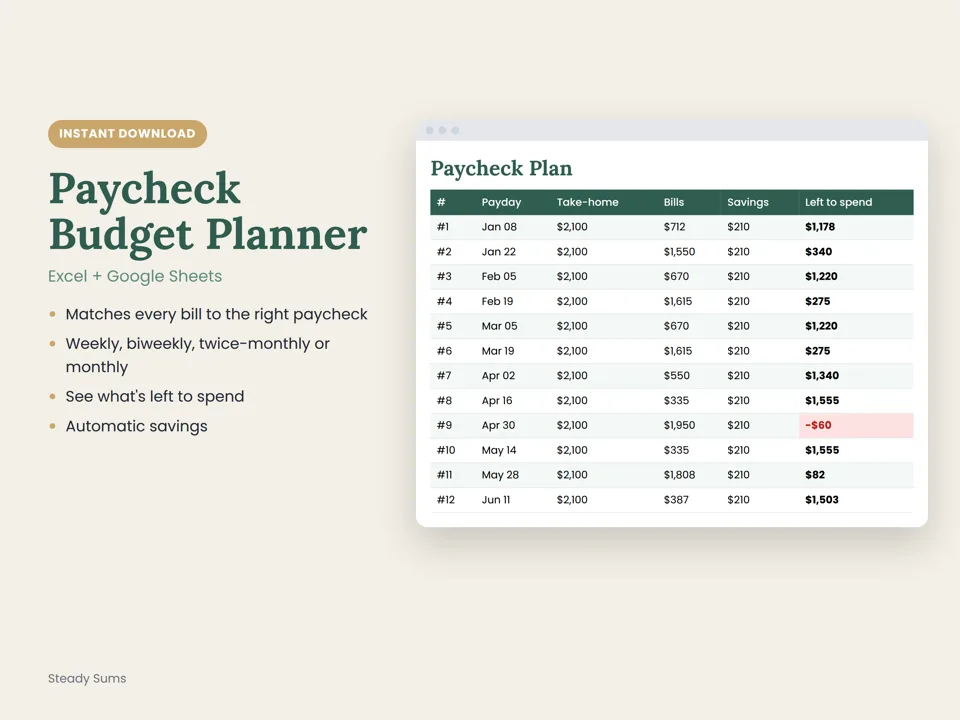
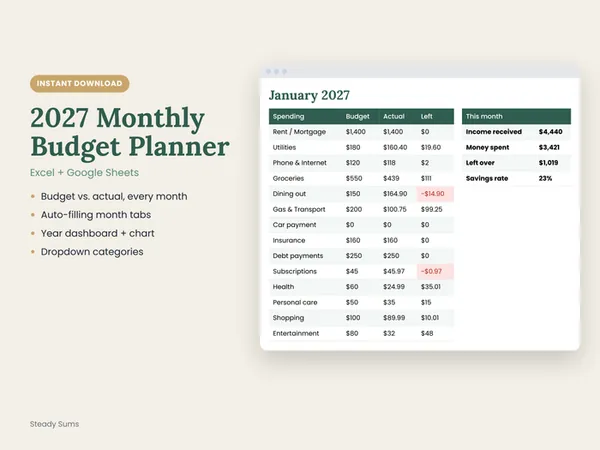
Plan every paycheck from your net pay.
Type in your take-home pay, match each bill to a paycheck and always know what's left to spend. Works in Excel and Google Sheets.
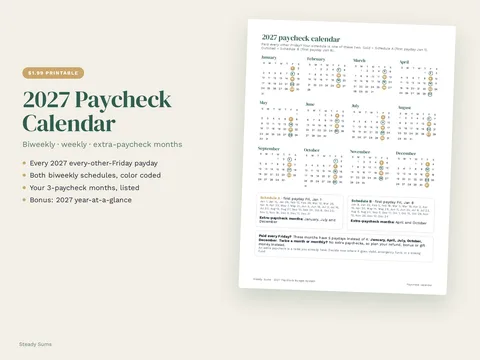
See all 26 paydays for 2027 at a glance.
A printable calendar with every biweekly payday and both 3-paycheck months marked, so you can plan them ahead.
Budget each paycheck the day it lands.
Budget, debt payoff and savings goals in one calm app, on your phone or computer. Free for 14 days, then $5/month. No card needed to start.
Try the Planner freeQuestions people ask
Why is my take-home pay less than my salary?
Taxes and deductions come out first: federal income tax, Social Security (6.2%), Medicare (1.45%), state or local tax if your area has it, plus anything you chose, like health insurance or a 401(k).
What is the difference between gross pay and net pay?
Gross pay is what you earned before anything comes out. Net pay is what is left after taxes and deductions, the amount that lands in your bank account.
What does YTD mean on a pay stub?
YTD means year to date: the running total for the calendar year so far. It is handy for checking your income and taxes before you file.
Does a 401(k) contribution lower my Social Security and Medicare taxes?
No. A traditional 401(k) contribution lowers the pay used for federal income tax, but Social Security and Medicare are still figured on that money.
Is my employer required to give me a pay stub?
Federal wage law requires employers to keep pay records but does not require pay stubs. Many states do require a written pay statement, so check your state's labor department.
Sources: IRS, Topic 751, Social Security and Medicare withholding rates; IRS, Tax Withholding Estimator; U.S. Department of Labor, FLSA questions and answers. Figures in the sample stub are an example, not your actual withholding.
Education only, not financial advice. Steady Sums shares general education; for decisions about your situation, talk to a licensed professional.
More money guides
How to stop living paycheck to paycheck
Running out before payday is stressful and common. These seven steps build breathing room one paycheck at a time.
Read the guide →The 50/30/20 budget rule, explained with real numbers
A simple starting point for splitting your paycheck, and what to do when real life doesn't fit neatly into it.
Read the guide →How to start budgeting (a simple beginner guide)
You don't need a perfect spreadsheet. You need five steps and about an hour.
Read the guide →Make it easier with the right tool
One calm money move a week.
A 3-minute Tuesday email with one simple step for budgeting, saving and paying off debt. Join free and get a printable $1,000 emergency fund tracker.
Free. One email a week. Unsubscribe any time.