If you're paid every two weeks, you get 26 paychecks a year, not 24. That sounds like a small detail, but it's why a monthly budget can feel tight in one half of the month and loose in the other. The fix isn't earning more. It's deciding, ahead of time, which paycheck pays for what.
Step 1: Write down your take-home pay per check
Use the amount that actually lands in your bank account after taxes, insurance and retirement contributions. If it changes a little from check to check (overtime, tips), use a typical low check. Budgeting on a lower number means good surprises instead of bad ones.
Step 2: List every bill with its due date
Rent or mortgage, utilities, phone, insurance, car payment, minimum debt payments, subscriptions. Next to each, write the day of the month it's due. This list is the backbone of a biweekly budget.
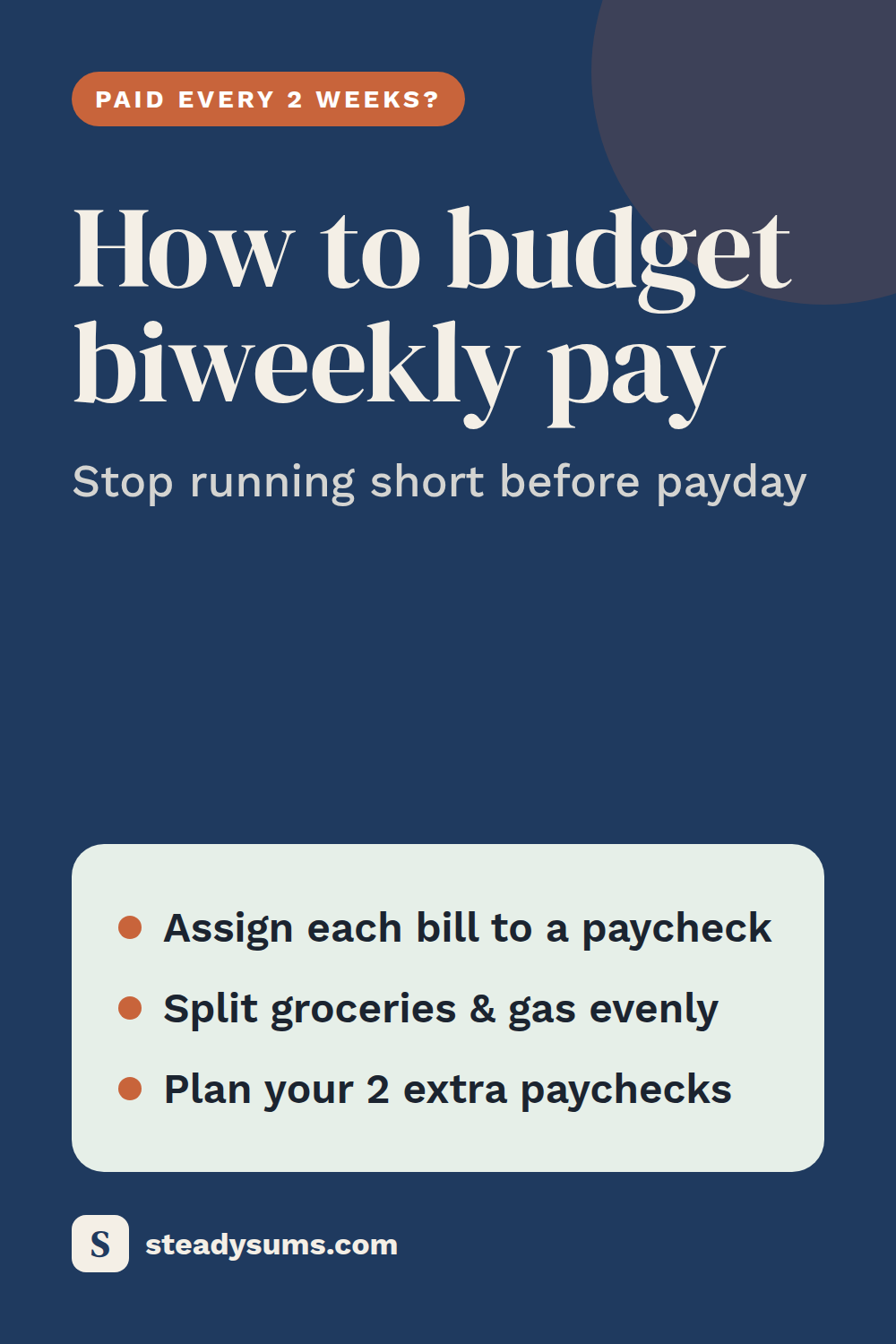
Step 3: Assign each bill to a paycheck
Go through your list and give each bill to the paycheck that arrives before its due date. A common split looks like this:
- Paycheck A (around the 1st): rent or mortgage, phone, a share of groceries.
- Paycheck B (around the 15th): utilities, car payment, insurance, a share of groceries.
If one paycheck is carrying far more than the other, see whether you can ask a lender to move a due date. Many credit card companies and utilities let you pick your due date once a year.
Step 4: Split everyday spending evenly
Groceries, gas and fun money don't have due dates, so divide them in half and take them out of each paycheck. If groceries run about $600 a month, that's $300 from each check. This keeps every two-week stretch livable.
Step 5: Plan for the two "extra" paychecks
Because there are 26 paychecks in a year, two months will have three paychecks instead of two. Since your bills are already covered by the first two, the third check is free to give a job:
- Top up your emergency fund.
- Make an extra payment on your highest-interest debt.
- Fund a sinking fund for a big yearly expense like car insurance or holidays.
Look at a calendar now and find your three-paycheck months. Knowing they're coming makes it much easier to use them on purpose.
A quick example
Jordan takes home $1,600 every two weeks. Rent is $1,200 on the 1st, utilities and phone are $250 on the 20th, a car payment is $300 on the 18th, and groceries run $500 a month.
- Paycheck on the 28th: rent $1,200 + groceries $250 = $1,450, leaving $150.
- Paycheck on the 11th: car $300 + utilities and phone $250 + groceries $250 = $800, leaving $800.
The second check has much more room, so Jordan sends $400 of it to savings and keeps $400 as a buffer. Nothing is due before the money for it arrives.
Common mistakes to avoid
- Budgeting on gross pay. Always use take-home pay.
- Forgetting yearly bills. Divide them by 26 and set that amount aside from every check.
- Spending the third paycheck by accident. Decide its job before it arrives.
Try the numbers yourself.
Our free paycheck budget calculator works it out in seconds. No sign-up.
Questions people ask
How many paychecks do you get a year if you're paid biweekly?
26. That's why two months each year have three paychecks instead of two.
Should I budget by month or by paycheck?
If you're paid every two weeks and bills feel tight before payday, budgeting by paycheck usually works better. You still set monthly totals, but you decide which check pays each bill.
What should I do with a third paycheck?
Since your regular bills are covered by the first two, give it a specific job: emergency savings, extra debt payments or a sinking fund for a big yearly expense.
Save this guide for later.
Pin it to your budgeting board so it's there when you need it.
Steady Sums shares general education, not financial advice. For decisions about your situation, talk to a licensed professional.
More guides
- Debt snowball vs. avalanche: which should you use?
- The 50/30/20 budget rule, explained with real numbers
- How much should be in your emergency fund?
- How to start budgeting (a simple beginner guide)
- Sinking funds: the easy way to pay for big expenses
- How a zero-based budget works (and how to start one)
- The cash envelope system: how cash stuffing works
- The 52-week savings challenge: how to save $1,378 in a year
- How to do a no-spend challenge (and actually save money)
- How to pay off credit card debt faster
- Compound interest explained simply
- How to budget when your income changes every month
- How to stop living paycheck to paycheck