Black Friday falls on the day after Thanksgiving in the US, which in 2026 is Friday, November 27, and the sales around it now stretch across most of November and into the following Monday. Stores plan for months to make you spend more than you meant to. The good news is that a little planning on your side works just as well.
The goal isn't to skip the sales. It's to use them for things you already planned to buy, like holiday gifts or a replacement for something worn out, and to leave everything else on the shelf.
Step 1: Set a spending cap before you see a single ad
Decide your total now, while you're calm. Your cap should come from your budget, not from the size of the discounts. Two good places to find it:
- Your holiday budget. If you've made one, your Black Friday cap is simply the part of your gift line you plan to spend that weekend. Our holiday budget guide shows how to set it up.
- Your November budget. Look at what's left after bills, groceries and savings. Our budget calculator shows it in a minute.
Write the cap down somewhere you'll see it while shopping, like the lock screen of your phone or the top of your list.
Step 2: Build your list in the two weeks before
Your list is what turns a sale into savings. Include only two kinds of items:
- Gifts already on your holiday gift list, with the price you planned for each.
- Planned replacements: things you would buy in the next few months anyway, like a worn-out coat, a failing appliance or kids' shoes they're about to outgrow.
For each item write three things: what it is, the most you'll pay, and the regular price you've seen. That last number matters for step 3.
Anything that isn't on the list gets a simple rule: it waits. You can add it to next month's list if you still want it, but not during the sale.
Step 3: Check whether the deal is actually a deal
A big "was" price doesn't always mean a big saving. A few quick checks:
- Compare with the price you wrote down. If you tracked the regular price in the weeks before, you'll know right away whether 40% off is real.
- Watch the model number. Some sale items, especially electronics, are special versions made for the sale with slightly different parts. Compare the exact model, not just the name.
- Count the full cost. Shipping, add-ons, extended warranties and "spend $X more for free shipping" nudges can wipe out the discount.
- Know that sales repeat. Many items go on sale again in December, January and at other points in the year. Missing one sale is rarely a real loss.
Step 4: Avoid the four classic traps
1. Buying for yourself while buying gifts
The most common leak. Retailers know you'll see something for you while you shop for others. If it's not on your list, it waits.
2. Countdown timers and "only 3 left"
Urgency is a sales tool. If you feel rushed, that's a signal to close the tab. A good rule: anything over a set amount (say $50) that isn't on your list gets a 24-hour pause. Our can I afford it check takes 30 seconds and gives an honest verdict.
3. Pay-later plans and new store cards
Splitting a purchase into installments, or opening a store card for an extra discount, makes it easy to spend past your cap because the full price never hits at once. Some plans charge fees or interest if a payment is late. If the purchase doesn't fit your cap in cash, it doesn't fit.
4. "Free" rewards that require spending more
Bonus gift cards or points for spending over a threshold only save money if you would have spent that much anyway. Otherwise they're a cost, not a reward.
Step 5: Track every purchase against your cap
Shopping across several stores and apps makes it easy to lose count. Keep a running total as you go: item, store, price, and what's left of your cap. Save every receipt and order email in one folder. If you'd rather not do the math by hand, a budget app with a "holiday gifts" category will show planned vs. spent automatically.
When you hit your cap, you're done, even if the sale isn't. What's left on your list can wait for December sales or be removed.
Step 6: Handle returns and price drops
- Note return windows. Many stores extend them for holiday purchases, but policies vary. Write the last return date next to anything you might send back.
- Return impulse buys quickly. If something slipped past your list, returning it within the window is a clean fix.
- Ask about price adjustments. Some stores refund the difference if the price drops within a short period after you buy. Check the policy before you assume.
Step 7: Move the "savings" to savings
If you bought something for $60 that normally costs $100, you saved $40 only if that $40 goes somewhere useful. Move it to your gift fund, emergency fund or an extra debt payment the same day. Otherwise it tends to become another purchase.
Some people prefer to sit the whole weekend out. If that's you, a no-spend weekend is a perfectly good Black Friday plan too, and our no-spend tracker makes it a game.
Extra tips if you shop online
- Fill carts early, buy late. Add list items to your cart in the days before, so on the day you're only checking prices, not browsing.
- Skip saved cards. Checking out as a guest or typing your card number adds a moment of friction that stops a lot of impulse buys.
- Check shipping dates. A cheaper item that arrives after the holiday may cost you a second, last-minute gift.
- Ask for gift receipts. They make returns and exchanges easier for the person you're giving to.
- Mute the noise. Unsubscribe from sale emails and turn off shopping app notifications for the week. You already know what you're looking for.
Your Black Friday plan on one page
| Before | During | After |
|---|---|---|
| Set your cap | Buy only list items | Check the total vs. cap |
| Write your list with max prices | Compare with regular prices | Return impulse buys |
| Note regular prices | 24-hour pause for extras | Move the savings |
Is that deal worth it? Check in 30 seconds.
Six quick taps give you a clear verdict, the price in hours of work, and a save-up plan.
Check a purchase →Try the numbers yourself
Our free budget calculator works it out in seconds. No sign-up.
Open the calculator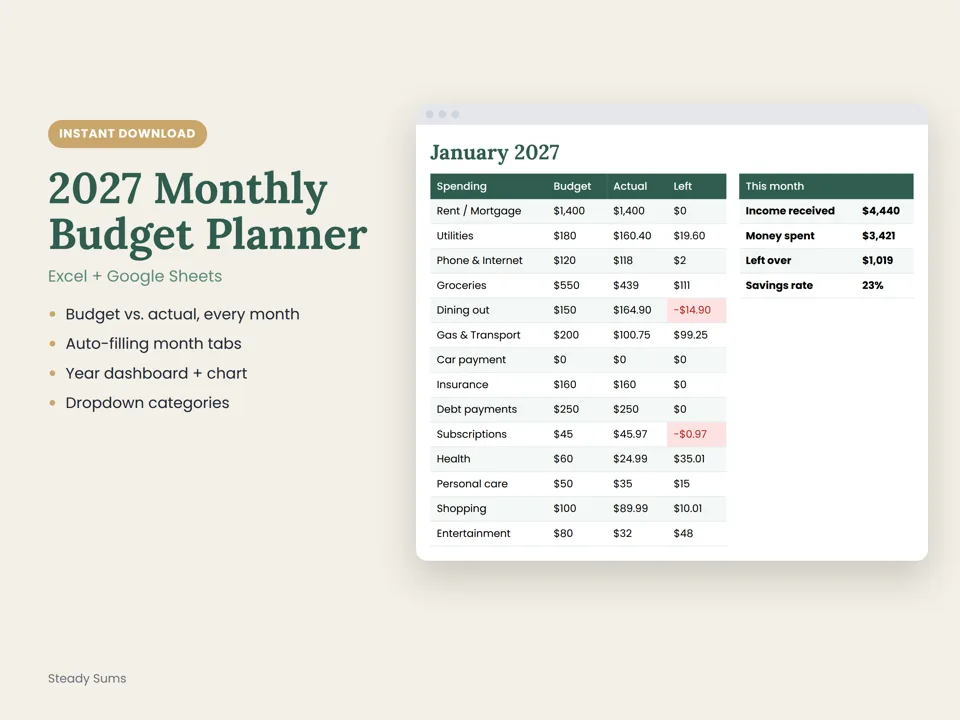
Want this done for you every month?
Our budget spreadsheet fills in each month automatically and shows budget vs. actual at a glance.
Set your spending cap and watch it in real time.
Budget, debt payoff and savings goals in one calm app, on your phone or computer. Free for 14 days, then $5/month. No card needed to start.
Try the Planner freeQuestions people ask
How much should I spend on Black Friday?
Only what fits in a cap you set in advance from your holiday or monthly budget. Pick the number before you see any ads, and stop when you reach it.
Are Black Friday deals really worth it?
Some are and some aren't. A deal is worth it when the item was already on your list and the price is lower than the regular price you've seen. Check the exact model and the full cost including shipping.
How do I avoid impulse buying on Black Friday?
Shop from a written list, give anything not on it a 24-hour pause, unsubscribe from sale emails, log out of saved cards and avoid countdown timers and pay-later offers.
Should I use a pay-later plan for holiday shopping?
Be careful. Splitting payments makes it easier to spend past your cap, and some plans charge fees if a payment is late. If a purchase doesn't fit your budget in cash, it's safer to skip it.
When is Black Friday 2026?
Black Friday 2026 is Friday, November 27, the day after Thanksgiving in the US. Many sales start earlier in November and run through the following Monday.
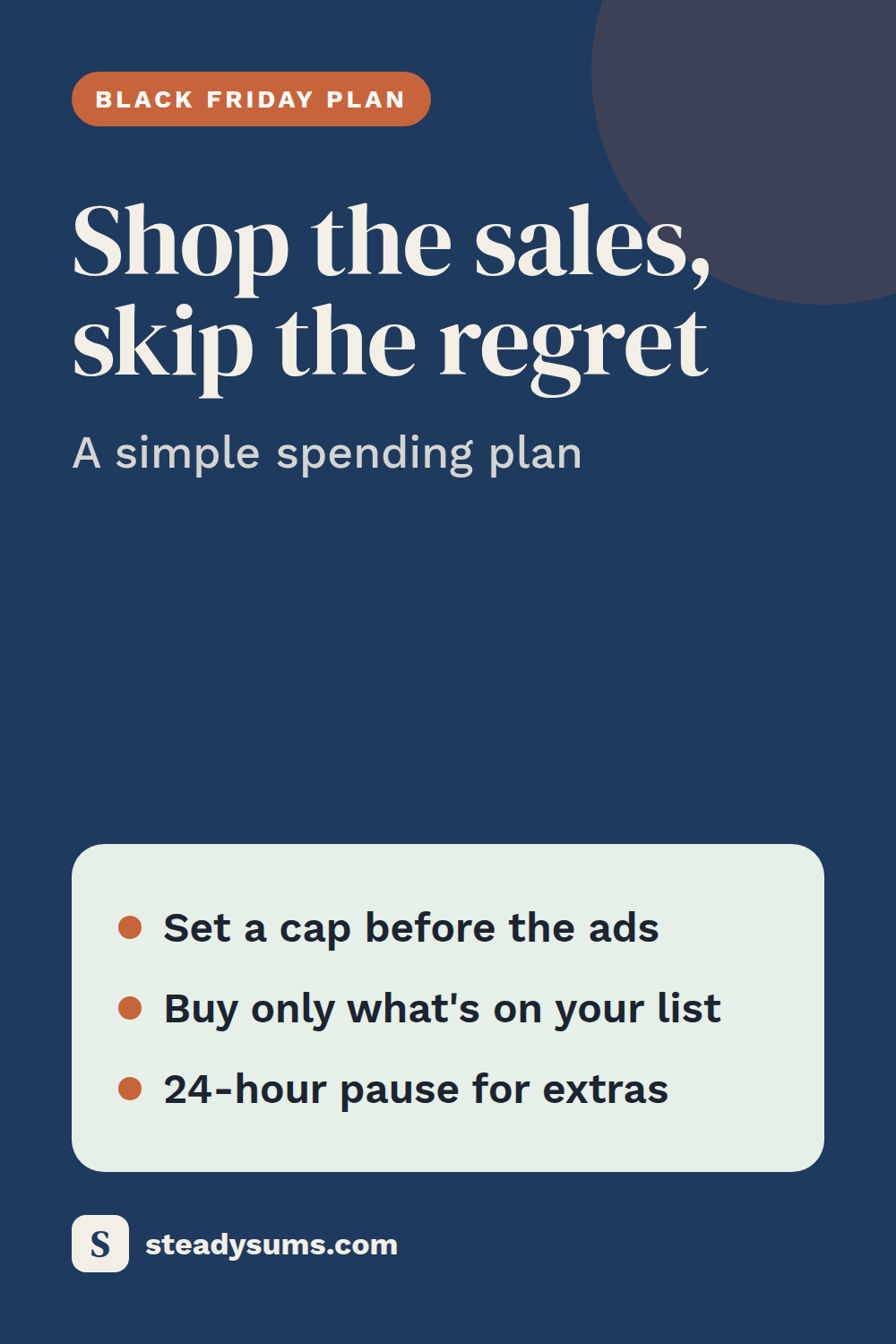
Save this guide for later.
Pin it to your budgeting board so it's there when you need it.
Steady Sums shares general education, not financial advice. For decisions about your situation, talk to a licensed professional.
More money guides
How to budget for Christmas (without a January hangover)
The holidays don't have to end with a card bill you're still paying in March. Pick one number, split it on paper, and let the list do the deciding.
Read the guide →How to start a Christmas savings fund (and how much to save each week)
$600 for the holidays feels big in December. Spread from January to mid-November, it's about $13 a week. Here's how to set up a gift fund that makes next December easy.
Read the guide →How to do a no-spend challenge (and actually save money)
Pause everything except the essentials for a set time. It's a quick reset that shows you exactly where your money usually leaks.
Read the guide →One calm money move a week.
A 3-minute Tuesday email with one simple step for budgeting, saving and paying off debt. Join free and get a printable $1,000 emergency fund tracker.