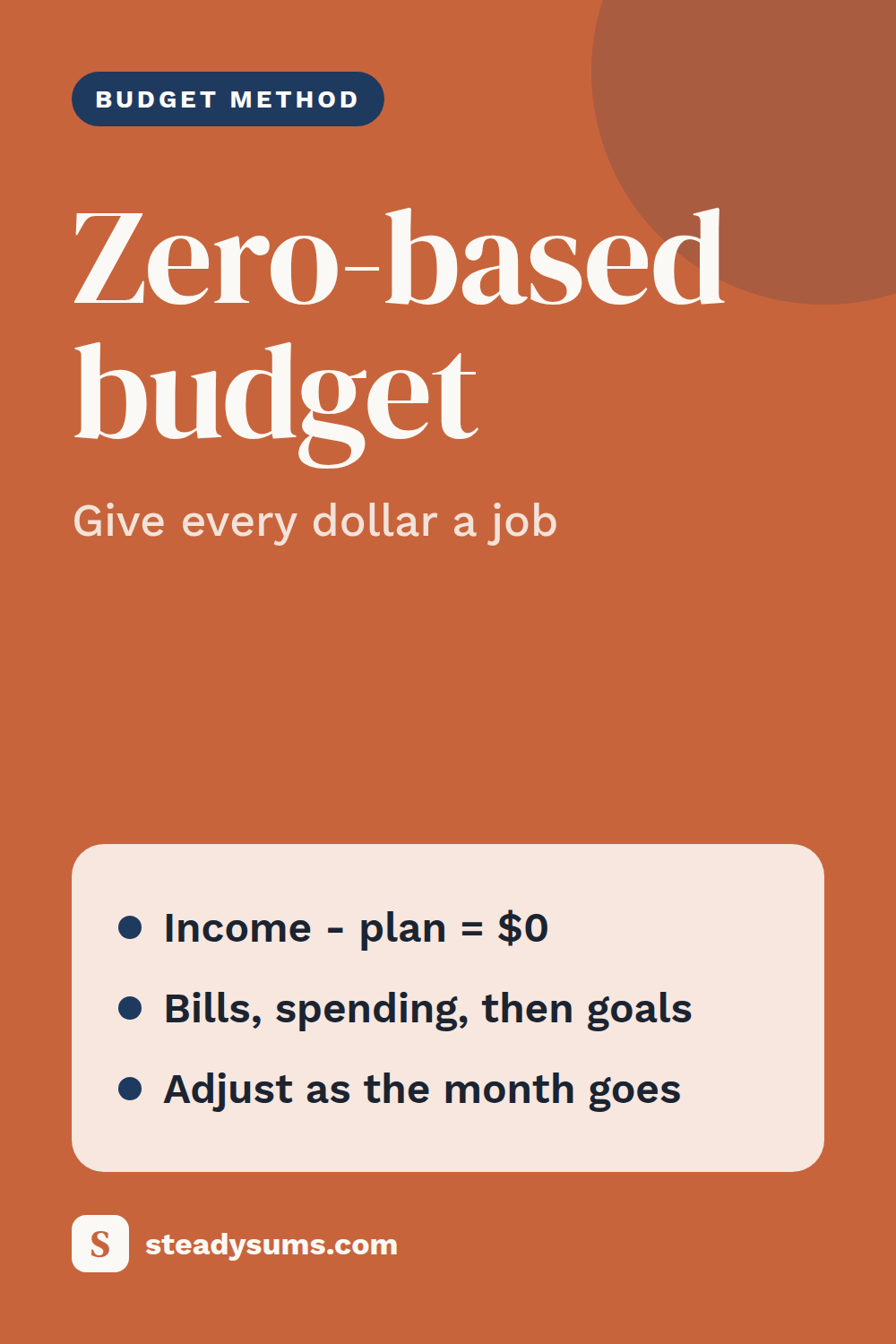
A zero-based budget means your income minus everything you plan to spend, save and pay toward debt equals zero. It doesn't mean your bank account hits zero. It means every dollar has been given a job before you spend it.
Step 1: Start with your take-home pay for the month
Use what actually lands in your account. If your pay changes month to month, use a low but realistic month.
Step 2: List your fixed bills
Rent or mortgage, utilities, phone, insurance, car payment and minimum debt payments. These come first because they aren't optional.
Step 3: Add your everyday spending
Groceries, gas, household items and eating out. Look at the last two months of bank statements to get honest numbers.
Step 4: Give the rest a job
Whatever is left goes to savings goals, extra debt payments or sinking funds for irregular costs like car repairs and holidays. Keep going until income minus all your categories equals zero.
Step 5: Adjust during the month
If groceries run $40 over, move $40 from another category. The total stays at zero. That flexibility is what makes this method stick.
A quick example
Sam takes home $3,800 a month:
- Rent $1,300, utilities and phone $220, car and insurance $420, minimum debt payments $150: $2,090
- Groceries $480, gas $160, household $60, eating out $120, fun money $100: $920
- Emergency fund $300, extra credit card payment $300, car repair fund $90, gifts fund $100: $790
$2,090 + $920 + $790 = $3,800. Every dollar has a job.
Zero-based budget vs. the 50/30/20 rule
The 50/30/20 rule is a quick starting split. A zero-based budget is more detailed and assigns exact amounts. Many people start with 50/30/20 and switch to zero-based once they want more control.
Try the numbers yourself.
Our free budget calculator works it out in seconds. No sign-up.
Questions people ask
Does a zero-based budget mean I have $0 in the bank?
No. It means every dollar of income is assigned to spending, saving or debt, so income minus your plan equals zero. The money you assign to savings stays in the bank.
Is zero-based budgeting good for beginners?
Yes, as long as you keep categories simple at first. Start with 8 to 12 categories and add more only if you need them.
What if I earn more than I planned?
Give the extra a job right away, such as savings or an extra debt payment, so it doesn't disappear into everyday spending.
Save this guide for later.
Pin it to your budgeting board so it's there when you need it.
Steady Sums shares general education, not financial advice. For decisions about your situation, talk to a licensed professional.
More guides
- How to budget when you're paid every two weeks
- Debt snowball vs. avalanche: which should you use?
- The 50/30/20 budget rule, explained with real numbers
- How much should be in your emergency fund?
- How to start budgeting (a simple beginner guide)
- Sinking funds: the easy way to pay for big expenses
- The cash envelope system: how cash stuffing works
- The 52-week savings challenge: how to save $1,378 in a year
- How to do a no-spend challenge (and actually save money)
- How to pay off credit card debt faster
- Compound interest explained simply
- How to budget when your income changes every month
- How to stop living paycheck to paycheck