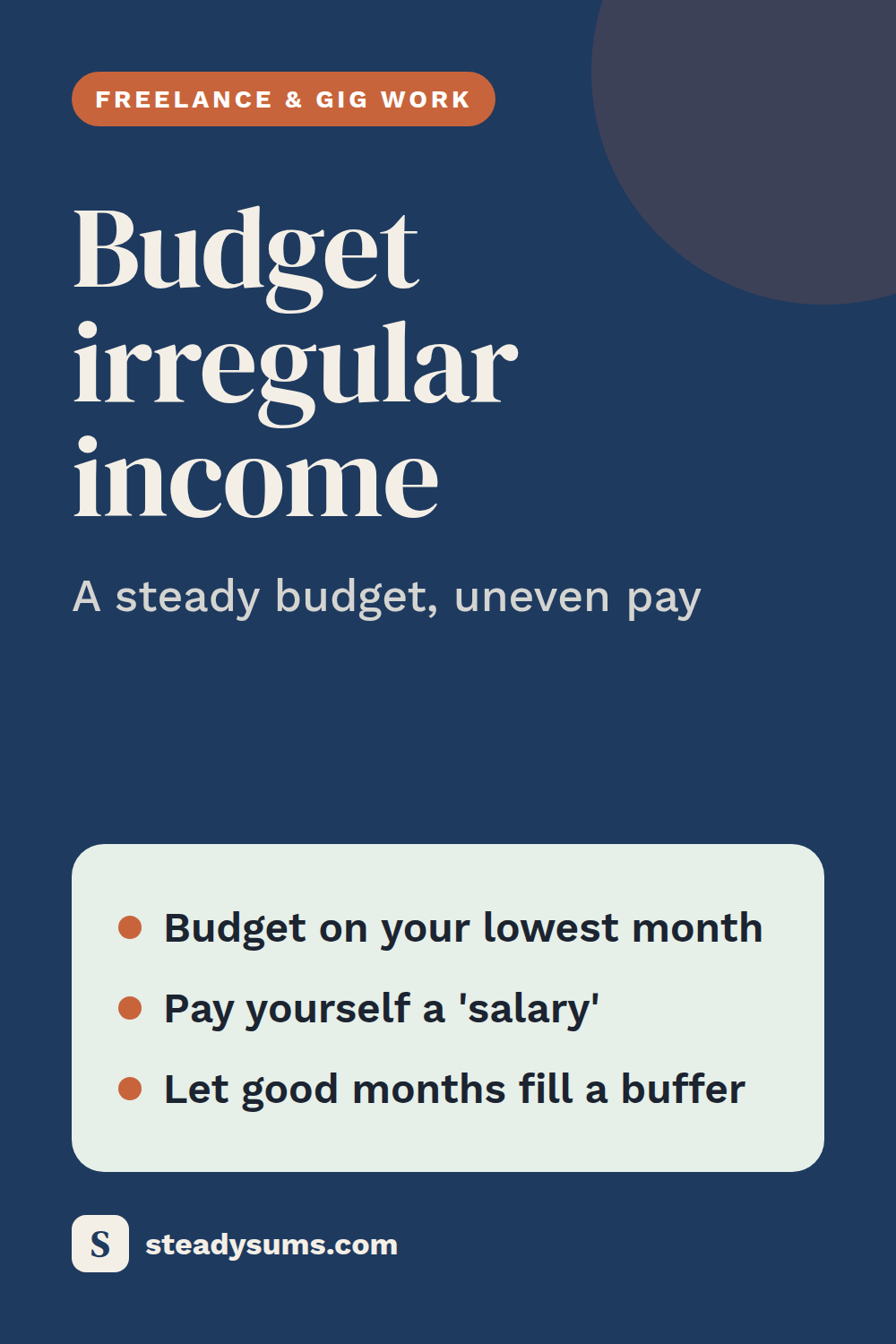
When your income changes month to month, a normal budget breaks. Good months feel rich, slow months feel scary. The fix is to budget as if every month were a slow one, and let good months fill a buffer.
Step 1: Find your baseline
Look at your take-home income for the last 6 to 12 months. Your baseline is your lowest month, or close to it. This is the number you budget on.
Step 2: Build a bare-bones budget
List what you truly need each month: housing, utilities, food, transportation, insurance, minimum debt payments. If your baseline covers these, you're in good shape. If not, this is where to trim.
Step 3: Set aside taxes first (if self-employed)
If no taxes are taken out of your pay, move a set percentage of every payment into a separate tax account the day it arrives. Many freelancers set aside 25% to 30%. A tax professional can help you pick the right number.
Step 4: Build an income buffer
Open a separate "income" savings account. All your pay goes there first. Each month, you pay yourself your baseline amount from it, like a salary. In good months, the extra stays in the account and covers the slow months.
Step 5: Decide what happens to extra money
Once your buffer holds one to two months of baseline expenses, give the overflow a job in this order:
- Your emergency fund (aim for more months than a salaried worker, since income is less predictable)
- High-interest debt
- Sinking funds and longer-term goals
A quick example
Alex's take-home ranged from $2,600 to $5,200 last year. Alex budgets on $2,800, pays that to checking on the 1st of each month from the income account, and lets the rest build up. After a strong spring, the buffer covers two slow months without stress.
Try the numbers yourself.
Our free paycheck budget calculator works it out in seconds. No sign-up.
Questions people ask
How do you budget with irregular income?
Budget on your lowest typical month, keep all income in a separate account, pay yourself a steady amount from it each month, and let good months build a buffer.
How big should my buffer be?
Start with one month of baseline expenses, then work toward two or more. The more your income swings, the bigger the buffer should be.
How much should freelancers save for taxes?
Many set aside 25% to 30% of each payment, but it depends on your income and location. A tax professional can help you choose.
Save this guide for later.
Pin it to your budgeting board so it's there when you need it.
Steady Sums shares general education, not financial advice. For decisions about your situation, talk to a licensed professional.
More guides
- How to budget when you're paid every two weeks
- Debt snowball vs. avalanche: which should you use?
- The 50/30/20 budget rule, explained with real numbers
- How much should be in your emergency fund?
- How to start budgeting (a simple beginner guide)
- Sinking funds: the easy way to pay for big expenses
- How a zero-based budget works (and how to start one)
- The cash envelope system: how cash stuffing works
- The 52-week savings challenge: how to save $1,378 in a year
- How to do a no-spend challenge (and actually save money)
- How to pay off credit card debt faster
- Compound interest explained simply
- How to stop living paycheck to paycheck