Credit cards often charge 20% or more in interest per year. At that rate, paying only the minimum can stretch a balance out for years. The good news: small increases in your payment make a big difference.
What an extra payment really saves
Take a $5,000 balance at 24% interest:
- Paying $150 a month: about 56 months to pay off and about $3,300 in interest.
- Paying $300 a month: about 21 months and about $1,100 in interest.
Doubling the payment cuts the time by nearly three years and saves over $2,000. (These are estimates. Your card's terms will change the exact numbers.)
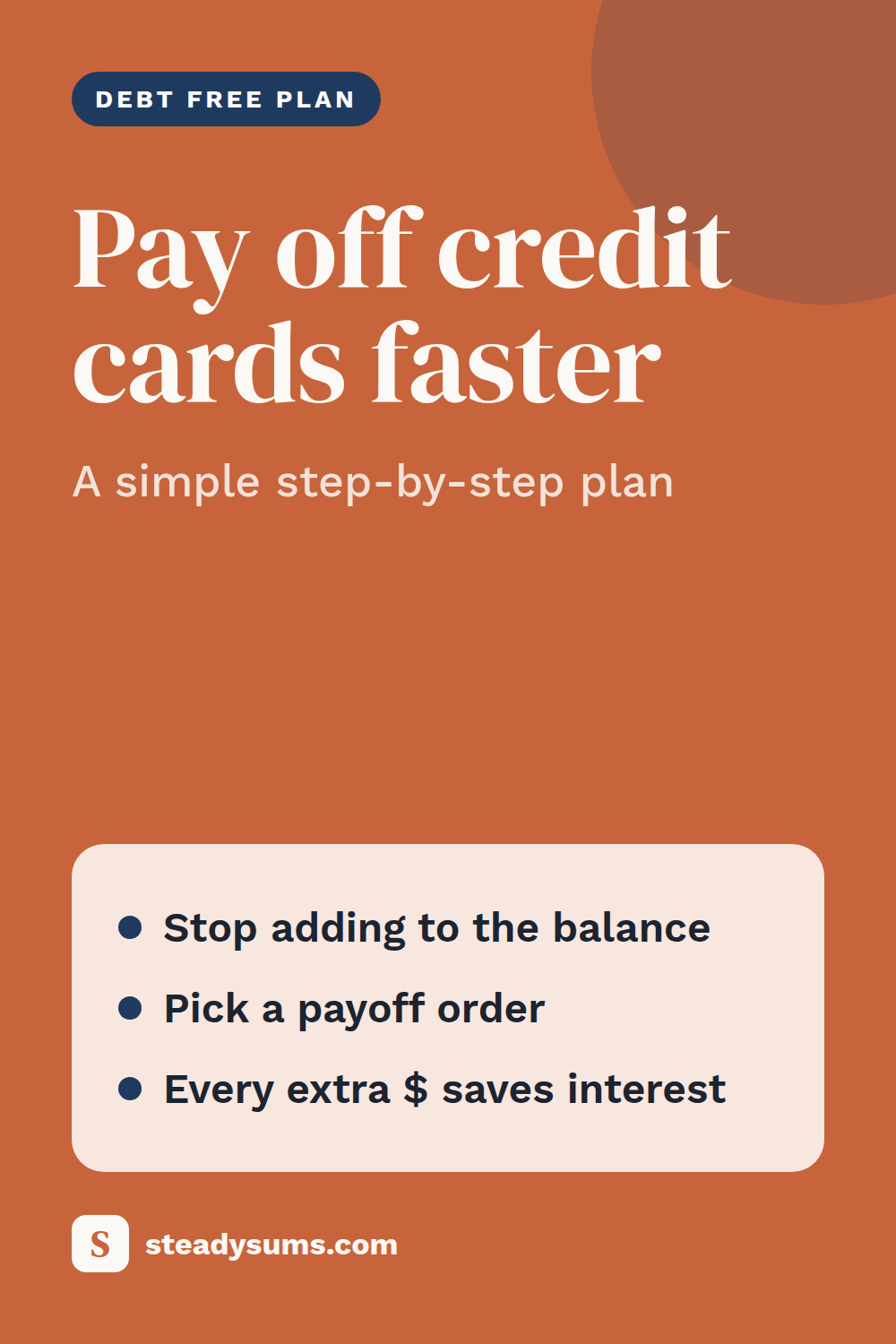
Step 1: Stop adding to the balance
Move the card out of your wallet and remove it from saved payment apps. Use cash or a debit card for everyday spending while you pay it down.
Step 2: List every card
Write down each balance, interest rate and minimum payment. Seeing them together is the first step to a plan.
Step 3: Choose a payoff order
Pay the minimum on every card, then put every extra dollar on one card:
- Avalanche: highest interest rate first. Saves the most money.
- Snowball: smallest balance first. Gives you quick wins.
Not sure which? Read debt snowball vs. avalanche.
Step 4: Find extra money
- Cancel subscriptions you don't use.
- Do a no-spend week and send the savings to the card.
- Put tax refunds, bonuses and three-paycheck months toward the balance.
Step 5: Ask for a lower rate
Call your card company and ask if they can lower your interest rate, especially if you've paid on time. It doesn't always work, but it costs nothing to ask.
What about balance transfers?
A 0% balance transfer card can save interest if you can pay off the balance before the promo ends. Check the transfer fee (often 3% to 5%) and the rate after the promo, and don't use the old card again.
This guide is general information, not financial advice.
Try the numbers yourself.
Our free debt payoff calculator works it out in seconds. No sign-up.
Questions people ask
What's the fastest way to pay off credit card debt?
Stop adding new charges, pay the minimum on every card, and put every extra dollar on the card with the highest interest rate (the avalanche method).
Should I pay off credit cards or save first?
Many people build a small starter emergency fund first, often around $1,000, so a surprise expense doesn't go back on the card, then focus on the debt.
Does paying more than the minimum really help?
Yes. Because interest is charged on the remaining balance, every extra dollar reduces future interest and shortens the payoff time.
Save this guide for later.
Pin it to your budgeting board so it's there when you need it.
Steady Sums shares general education, not financial advice. For decisions about your situation, talk to a licensed professional.
More guides
- How to budget when you're paid every two weeks
- Debt snowball vs. avalanche: which should you use?
- The 50/30/20 budget rule, explained with real numbers
- How much should be in your emergency fund?
- How to start budgeting (a simple beginner guide)
- Sinking funds: the easy way to pay for big expenses
- How a zero-based budget works (and how to start one)
- The cash envelope system: how cash stuffing works
- The 52-week savings challenge: how to save $1,378 in a year
- How to do a no-spend challenge (and actually save money)
- Compound interest explained simply
- How to budget when your income changes every month
- How to stop living paycheck to paycheck