Most holiday overspending doesn't come from one big purchase. It comes from dozens of small ones that never had a plan: an extra gift for a coworker, a second grocery run for a party, shipping costs, a last-minute outfit. A holiday budget fixes that by deciding the total before the season starts, then giving every part of it a job.
This guide walks you through it in six steps. It takes about 30 minutes, and you only need your bank app, a pen and a rough idea of who you're buying for.
Step 1: Find a number you can actually afford
Start with what you have, not what you'd like to spend. There are three honest sources of holiday money:
- Money already saved for the holidays (a gift fund or sinking fund).
- Room in your next few paychecks after bills, groceries, gas and minimum debt payments. Our budget calculator shows what's left over each month.
- Planned cuts between now and December, such as pausing takeout or a subscription for two months.
Add those three together. That is your holiday number. Anything above it would have to go on a credit card, and at typical card interest rates a balance you carry into the new year keeps growing every month you don't pay it off.
A quick example: you have $150 set aside, you can free up $175 from each of your October, November and December budgets, and you'll skip takeout for two months to free up another $120. Your holiday number is $150 + $525 + $120 = $795.
Step 2: Split the number into holiday categories
Gifts get all the attention, but they're rarely the whole cost. Give each of these its own line so nothing sneaks up on you:
| Category | What it covers | Example share |
|---|---|---|
| Gifts | Family, friends, teachers, coworkers, gift exchanges | About half |
| Food and hosting | Holiday meals, baking, party snacks, dishes to bring | About a fifth |
| Travel | Gas, tickets, pet sitting, a hotel night | Varies a lot |
| Decor and cards | Tree, lights, cards and postage, wrapping | Small |
| Events and extras | Outfits, tickets, donations, tips for service workers | Small |
| Buffer | The thing you forgot | About 5 to 10% |
The shares are only a starting point. If you're hosting, food gets more. If you're flying home, travel may be the biggest line and gifts need to shrink to fit. What matters is that the lines add up to your holiday number, not a dollar more.
Using the $795 example: gifts $400, food $150, travel $100, decor and cards $40, extras $45, buffer $60. Total: $795.
Step 3: Make a gift list with a price next to every name
Write down everyone you plan to buy for, then put a dollar amount next to each name before you shop. Add them up. If the total is bigger than your gift line, trim now, on paper, where it's painless.
A few ways to make the list fit:
- Tier your list. Close family gets one amount, extended family and friends a smaller one, coworkers and neighbors a small token or a card.
- Suggest a gift exchange. One name each in a family or friend group, with a set price, often saves everyone money and stress.
- Give together. Siblings can go in on one nicer gift for a parent instead of three small ones.
- Give time or skills. A home-cooked dinner, babysitting, or help with a project are real gifts.
- Remember the hidden costs. Wrapping, gift bags, batteries and shipping can add a surprising amount. Put them in the gift line.
Step 4: Put your spending plan on a calendar
Holiday spending is spread across about eight weeks, and so are your paychecks. Match them up:
- Early November: buy anything that has to ship far away, and book travel.
- Late November: sale shopping, but only for items already on your list. Our Black Friday spending plan shows how.
- Early December: cards, decor, event tickets and the last gifts.
- Mid to late December: holiday food and hosting.
Then assign each chunk to a paycheck. If you're paid every two weeks, our biweekly budgeting guide helps you see which check can carry what.
Step 5: Track as you go (this is where most plans fail)
A holiday budget only works if you know how much is left in each line while you're shopping. Pick one simple way to track it and use it every time you buy something:
- A note on your phone with each category and a running total.
- Envelopes, if you like the cash envelope system. When the gift envelope is empty, gift shopping is done.
- A budget app that shows planned vs. spent for each category.
If one line runs over, move money from another line rather than adding new money. Spent $30 more on gifts? Take it from decor or the buffer. The total stays the same.
Step 6: Close out the season and set up next year
In early January, spend five minutes on a quick review:
- Add up what you actually spent in each category.
- Note what surprised you. Was it shipping? A second party? Travel?
- Divide next year's holiday number by the months you have left. That's your monthly gift fund amount.
Starting a fund in January is the single change that makes next December easiest. Our guide to starting a Christmas savings fund walks through the math week by week.
What if you've already overspent?
It happens. Stop adding to it first: pause any shopping that isn't on your list. Then look at your January budget and decide how much you can put toward the balance each month. If it's on a credit card, our debt payoff calculator shows how long it will take and how much interest you'll pay, and the credit card payoff guide has a step-by-step plan. A new year budget reset is a good time to build it in.
A holiday budget checklist
- Holiday number decided from savings, spare room in paychecks and planned cuts
- Number split into gifts, food, travel, decor, extras and a buffer
- Gift list written with a price next to every name
- Shopping timeline matched to paychecks
- One tracking method chosen and used every time
- January review on the calendar
Tempted by a big holiday purchase?
Six quick taps give you a clear verdict, the price in hours of work, and a save-up plan.
Check a purchase →Try the numbers yourself
Our free budget calculator works it out in seconds. No sign-up.
Open the calculator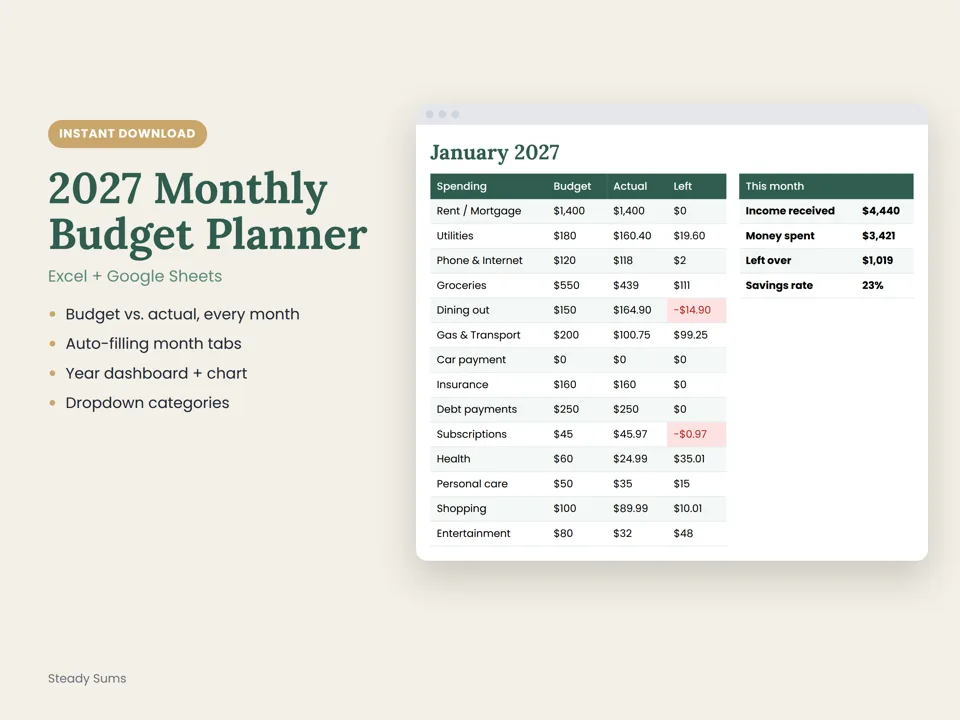
Want this done for you every month?
Our budget spreadsheet fills in each month automatically and shows budget vs. actual at a glance.
Plan your holiday budget and see it next to your regular bills.
Budget, debt payoff and savings goals in one calm app, on your phone or computer. Free for 14 days, then $5/month. No card needed to start.
Try the Planner freeQuestions people ask
How much should I spend on Christmas?
Spend only what you can pay for with money you've saved, spare room in your next few paychecks, and cuts you've planned. If the total would need a credit card balance you can't pay off in full, lower the number.
How do I make a holiday budget?
Pick a total you can afford, split it into categories like gifts, food, travel, decor and a small buffer, write a gift list with a price next to each name, and track spending in each category as you go.
What should be included in a holiday budget besides gifts?
Holiday meals and hosting, travel, cards and postage, wrapping and shipping, decorations, event tickets, outfits, donations and tips. A 5 to 10% buffer covers what you forget.
How can I spend less on gifts without seeming cheap?
Tier your list by closeness, suggest a gift exchange with a set price, go in on a group gift, or give time and skills such as a cooked meal or help with a project. Most people appreciate thoughtfulness more than price.
When should I start saving for Christmas?
January is ideal because you have the most weeks to spread the cost. Divide next year's holiday number by the weeks or months left and save that amount each payday.
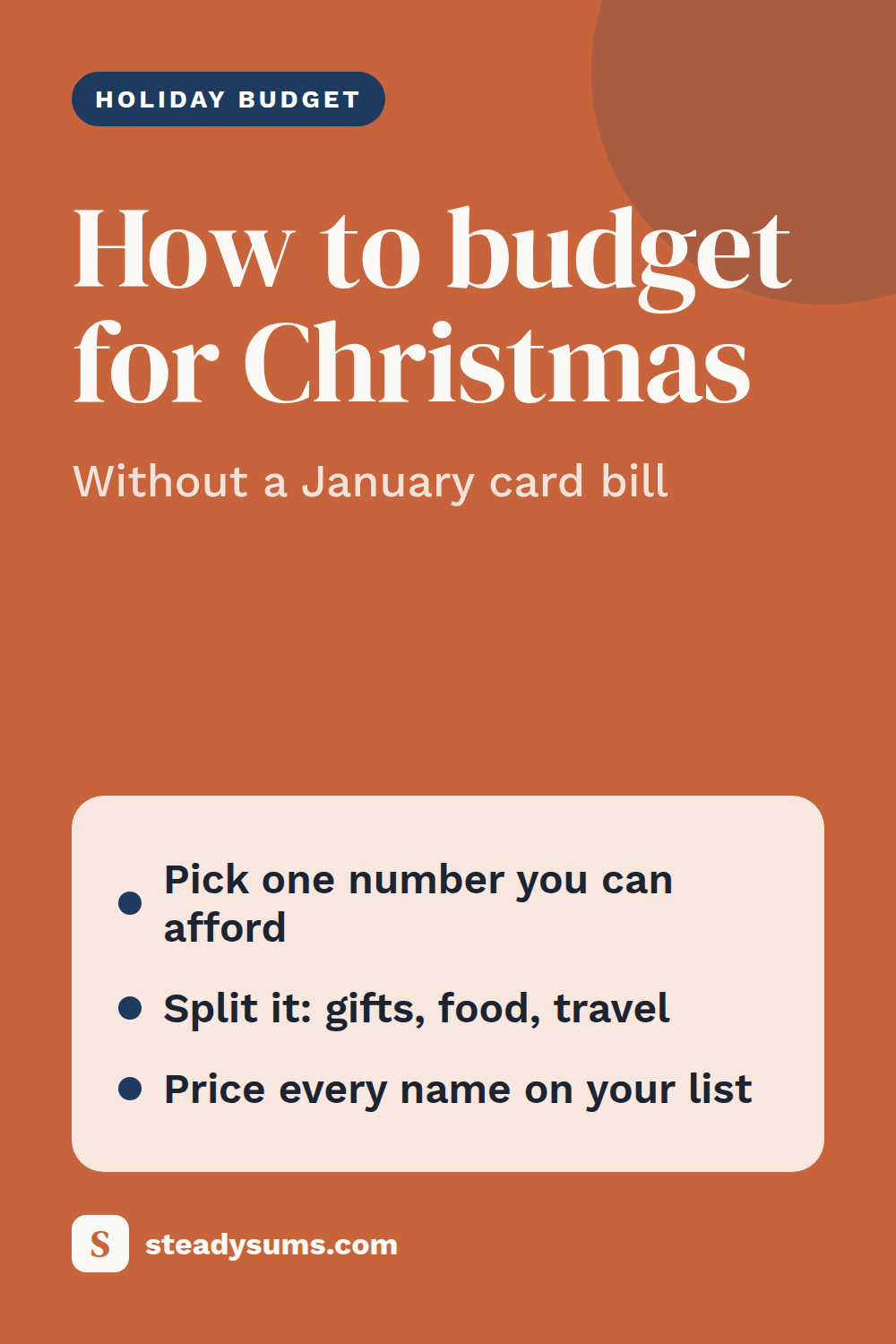
Save this guide for later.
Pin it to your budgeting board so it's there when you need it.
Steady Sums shares general education, not financial advice. For decisions about your situation, talk to a licensed professional.
More money guides
How to start a Christmas savings fund (and how much to save each week)
$600 for the holidays feels big in December. Spread from January to mid-November, it's about $13 a week. Here's how to set up a gift fund that makes next December easy.
Read the guide →A Black Friday spending plan that actually saves you money
A sale only saves money if you were going to buy the thing anyway. Here's how to walk into the biggest shopping weekend with a list, a cap and a plan for impulse buys.
Read the guide →The new year budget reset: 7 steps for a calmer January
January is the easiest month to change your money habits. Here's a simple reset you can finish in one weekend, with an optional no-spend challenge to kick it off.
Read the guide →One calm money move a week.
A 3-minute Tuesday email with one simple step for budgeting, saving and paying off debt. Join free and get a printable $1,000 emergency fund tracker.